How to develop colour film (C-41) at home
To develop colour negative film at home, you use a C-41 kit: a colour developer at about 38 °C, then a bleach and a fixer (or one combined bleach-fix), a wash and a final rinse. The steps are no harder than black and white. The difference is temperature: the developer must stay within about 1 °C of its target, and a water bath with a sous vide stick does that well.
What you need
- A C-41 kit. The kits below are available now.
- A developing tank and reels, the same ones you use for black and white.
- Temperature control. A large container of water with a sous vide stick, or another immersion heater with a thermostat. A big enough plain water bath also works if it does not cool by more than 1 °C during the developer step, as Adox puts it.
- An accurate thermometer.
- Bottles for each working solution, ideally brown glass that you can fill to the top.
- Gloves, safety glasses and an apron, and a room with good ventilation.
- Distilled or deionised water for the final rinse if your tap water is hard.
Set the sous vide stick to your developer temperature and let the bottles stand in the water until they reach it. Measure inside the developer bottle, not in the bath.
C-41 kits you can buy
| Kit | Baths | Developer step | Capacity | Notes |
|---|---|---|---|---|
| CineStill Cs41 | 2: developer and bleach-fix, plus an optional final rinse | 3 min 30 s at 39 °C (102 °F) | 8 rolls of 135-36 or 120 per quart for consistent results; up to 24 with longer times | Liquid or powder. A chart gives times at lower temperatures |
| Adox C-TEC 41 | 2: developer and bleach-fix, plus a stabiliser | 3 min 15 s at 38 °C, or 8 min at 30 °C | Up to 16 rolls of 35mm or 120 per 1 litre kit | Adox recommends 30 °C for home use. Times grow as you use the kit |
| Kodak C-41 kit, made under licence by Photo Systems | 4: developer, bleach, fixer, final rinse | 3 min 15 s at 37 to 39 °C in a small tank | Up to 20 rolls from the 2.5 litre kit, used one-shot; more if you replenish | Separate bleach and fixer. Mixed developer keeps 1 week |
Bellini and Flic Film also sell C-41 kits. Whichever kit you buy, use the times in its own instructions.
Two-bath kits combine the bleach and the fixer in one bath, called a bleach-fix or blix. The Kodak kit keeps them apart, as a lab does, which takes longer but gives each bath one job.
Control the temperature
Colour film is much less forgiving of temperature than black and white. You can develop black and white film over a wide range of temperatures, because the data sheets convert the time. A C-41 developer is designed for 38 °C, and Adox gives a tolerance of plus or minus 1 °C for the developer step. Colour film has three layers, one per colour, and a temperature error does not develop them equally: you get colour shifts as well as density changes, and those are harder to correct in a scan.
A setup that works:
- Fill a large container with water and set a sous vide stick to your developer temperature. The more water, the steadier it stays.
- Stand the bottles of chemistry in the bath until they reach temperature. Adox’s advice: measure the temperature inside the bottle, not in the bath.
- Pre-heat the tank. Adox fills the loaded tank with water from the bath for 5 minutes. CineStill notes that cold film can drop the developer temperature by 1 to 2 °C, and recommends aiming about 1 °C high when you process by hand.
- Keep the tank in the bath between agitations.
After the developer step, temperature matters much less. Adox says so directly, and the Kodak kit accepts 24 to 41 °C for the bleach, fixer and washes.
If 38 °C is hard to hold, work cooler. Adox gives times for 30 °C. CineStill’s chart goes down to 22 °C (72 °F), where the developer step takes 50 minutes.
How I do it. I develop C-41 at home with an Argentix C-41 kit. A sous vide circulator heats the water, and insulated containers keep my chemicals at temperature. For dilution and temperature, I follow the instructions on the packaging to the letter.
The C-41 steps
The Kodak kit in a small tank, from its instructions:
| Step | Time | Temperature | Agitation |
|---|---|---|---|
| Developer | 3:15 | 37 to 39 °C | 30 s at first, then 2 s every 15 s |
| Bleach | 6:30 | 24 to 41 °C | 30 s at first, then 2 s every 30 s |
| Wash | 1:30 | 24 to 41 °C | Running water, or fill, agitate 5 s and dump, repeated |
| Fixer | 6:30 | 24 to 41 °C | 30 s at first, then 5 s every 30 s |
| Wash | 3:15 | 24 to 41 °C | As the first wash |
| Final rinse | 1:30 | 24 to 41 °C | 30 s at first, then none |
| Dry | As needed | 24 to 43 °C | Hang with a weighted clip, in a dust-free place or a drying cabinet |
Kodak describes one agitation cycle as turning the tank over with a slight rotation and back, at about one cycle per second.
With a two-bath kit the sequence is shorter. CineStill Cs41: developer 3 min 30 s at 39 °C, bleach-fix 8 minutes at 24 to 40 °C, wash 3 minutes, then the optional final rinse for 30 seconds to 1 minute. Adox C-TEC 41 at 38 °C: developer 3 min 15 s, a 30-second warm wash, bleach-fix 4 minutes, a 6-minute wash and the stabiliser for 1 minute.
Stabiliser or final rinse
Older C-41 processes ended in a stabiliser with formaldehyde. CineStill says modern films do not need it, because the stabiliser is now built into the emulsion. A final rinse with a wetting agent still helps the film dry clean, and CineStill’s rinse also helps prevent organic growth on stored negatives. CineStill adds that film more than 20 years old may still need a formaldehyde-based stabiliser.
Capacity and reuse
Every roll weakens the developer, and so does air. Kits handle this in two ways:
- One-shot. You use fresh developer for each run and discard it. This is the most consistent.
- Reuse with longer times. CineStill adds 2% to the developer time for each roll already processed in a quart. Adox gives a table: at 38 °C, 3 min 15 s for films 1 to 4, then 3 min 30 s, 3 min 45 s and 4 minutes, with the bleach-fix rising from 4 to 15 minutes.
Mixed chemistry does not keep long. Kodak gives 1 week for the mixed colour developer and 24 weeks for the bleach and fixer. Adox gives up to 6 weeks for its working solutions in full, airtight brown bottles. Keep the developer clean: CineStill warns that a few drops of bleach-fix or soap can ruin it.
Push processing
C-41 film can be pushed by extending only the developer step. Adox adds 30 seconds per stop at 38 °C. CineStill multiplies the developer time by 1.30 for one stop, 1.75 for two and 2.50 for three. CineStill notes that pushing raises contrast and colour saturation. Rate the whole roll at the same speed.
Motion picture film (ECN-2)
Cinema camera films, such as Kodak Vision3, have a black rem-jet backing and are made for the ECN-2 process. CineStill warns that the backing must come off before processing, and that these films should not share chemistry with other rolls. CineStill’s own colour films have no rem-jet and develop normally in C-41.
Work safely
Colour chemistry is harsher than black and white. CineStill’s own safety notes say one part of its Cs41 developer may cause severe skin burns, and another is suspected of causing cancer. Wear gloves and safety glasses every time, and an apron or lab coat. Work in a ventilated room, away from food, and never use kitchen equipment for chemistry. Read the maker’s safety data sheet before you mix, and follow your local rules when you dispose of used chemistry.
Common problems
From the Kodak and Adox troubleshooting tables:
- Negatives too dark. Overexposure, developer time too long, or contaminated developer.
- Negatives too light. Underexposure, a tank that was not pre-heated, or developer time too short.
- Uneven colour or streaks. Not enough solution in the tank, no pre-heat, or developer poured in too slowly.
- Colour fog. Dirty mixing vessels or contaminated developer.
- Brownish mask, or negatives that look magenta. The bleach or fixer step was too short or exhausted. Bleach and fix the film again, then wash and dry it.
- Drying spots. Hard water in the final rinse. Kodak suggests mixing tap water with distilled or demineralised water. Dry film without water spots has more.
- A colour cast in the scan. Not always a processing fault: colour casts in film scans covers the causes and fixes.
When the negatives look right, convert film negatives explains how to turn them into photos.
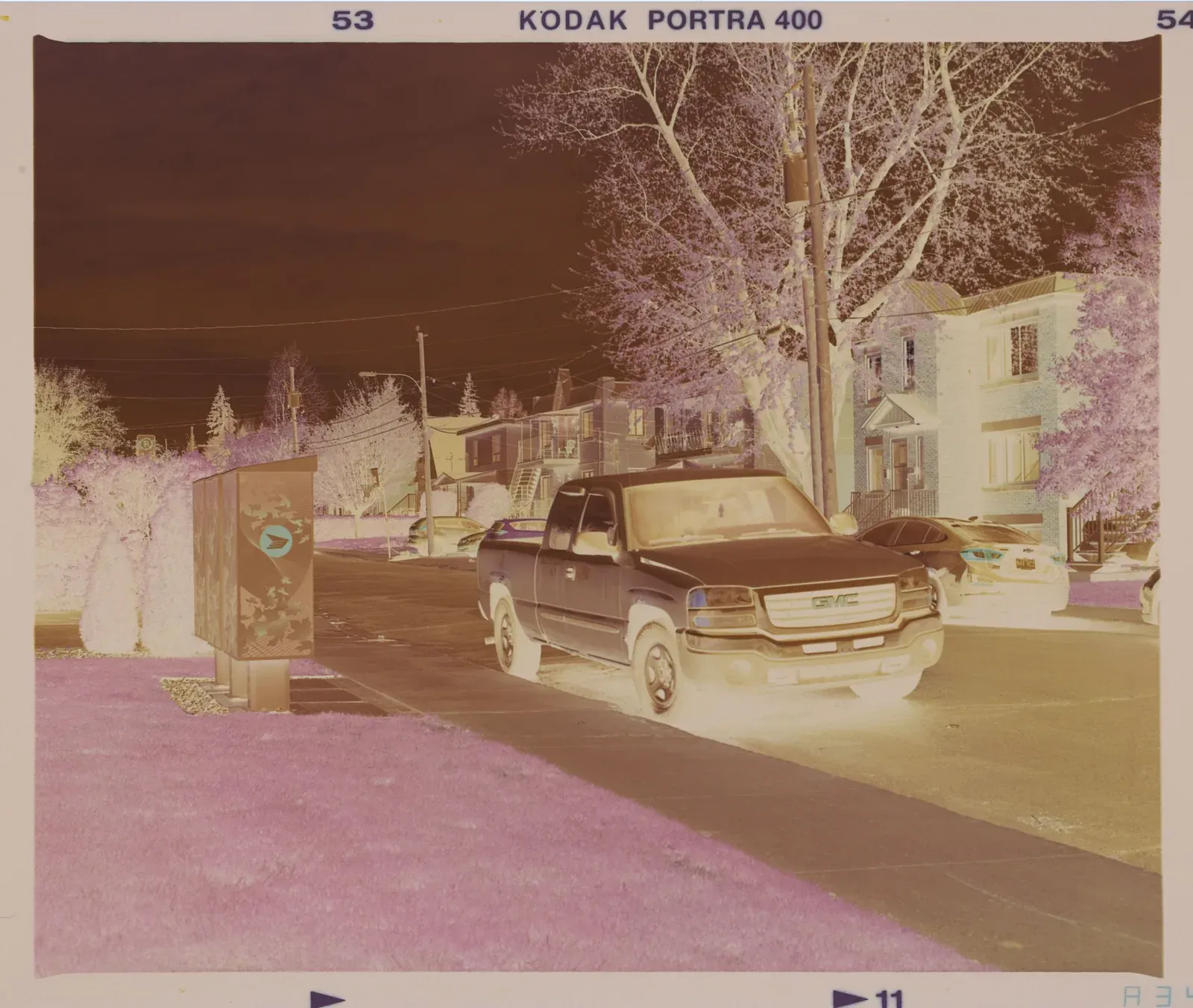 Negative
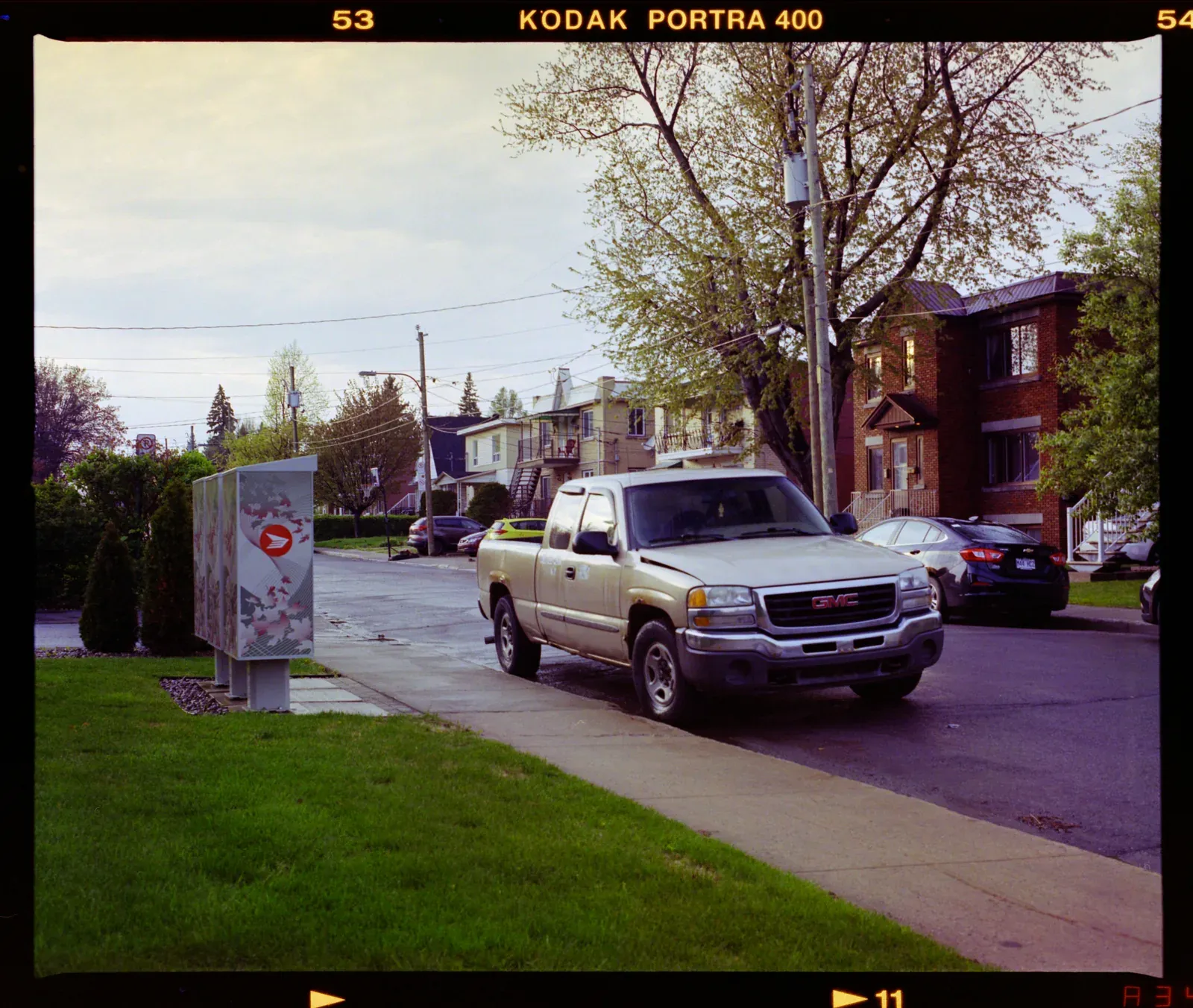 Converted
A frame of Kodak Portra 400 on the light panel, and the photo it makes. The orange mask is even across the film, and the edge print is dark and sharp.